How to Stop Puppy Biting: The Complete Guide (2026)

How to Stop Puppy Biting: The Complete Guide (2026)
If you're reading this with tiny tooth marks on your hands and shredded sleeves on your favorite shirt, take a breath. You're not alone, and your puppy isn't broken.
Puppy biting is one of the most common frustrations new puppy owners face — and one of the most misunderstood. The good news? With the right approach, consistency, and a bit of patience, you can teach your puppy to use their mouth gently and eventually stop biting altogether.
This guide walks you through everything you need to know: why your puppy bites, when it's normal versus when it's a concern, and the exact step-by-step techniques that professional trainers use to curb biting for good.
Why Do Puppies Bite in the First Place?
Before we can fix the problem, we need to understand it. Puppies bite for several completely normal, developmentally appropriate reasons:
They explore the world with their mouths. Puppies don't have hands. Their mouth is their primary tool for investigating textures, objects, and yes — your fingers. This is called "mouthing," and it's a natural part of how dogs learn about their environment.
They're teething. Between 3 and 6 months of age, puppies lose their baby teeth and grow adult teeth. This process is uncomfortable, and chewing provides relief. If your puppy seems to be biting everything in sight during this window, teething is likely a major factor.
They're learning bite inhibition. In a litter, puppies learn how hard they can bite during play. When one puppy bites too hard, the other yelps and stops playing. This teaches the biter that too much pressure ends the fun. When puppies come home to us, that education continues — but now we're the teachers.
They're overstimulated or overtired. Just like toddlers, puppies get cranky when they're exhausted. Overtired puppies often become "bitey" puppies. If your pup has been awake for more than an hour and the biting ramps up, tiredness is probably the culprit.
They want your attention. Puppies are smart. If biting gets a big reaction — even a negative one — they learn that biting is an effective way to get you to engage with them.
When Is Puppy Biting Normal vs. Concerning?
Most puppy biting is completely normal. Here's a quick way to tell the difference:
Normal Puppy Biting
- Happens during play or when the puppy is excited
- The puppy's body language is loose and wiggly
- Biting is accompanied by a play bow, bouncing, or a wagging tail
- It occurs more during teething (3 to 6 months)
- The puppy can be redirected to a toy fairly easily
Potentially Concerning Behavior
- The puppy's body goes stiff before biting
- Biting is accompanied by growling that doesn't sound playful
- The puppy snaps when you approach their food, toys, or resting space
- Biting happens when the puppy seems genuinely scared or cornered
- The behavior intensifies despite consistent training
If you're seeing signs from the "concerning" list, it's worth consulting a certified professional dog trainer (CPDT-KA) or a veterinary behaviorist. There's no shame in getting expert help early — in fact, it's the smartest thing you can do.
Step-by-Step: How to Stop Puppy Biting
Here's the method that professional trainers recommend. It's built entirely on positive reinforcement, and it works with your puppy's natural development rather than against it.
Step 1: Teach Bite Inhibition First
This might sound counterintuitive, but your first goal isn't to stop biting entirely. It's to teach your puppy to bite softly.
Why? Because every dog, no matter how well-trained, might mouth a person at some point in their life — during play, at the vet, or if they're startled. A dog who has learned bite inhibition will mouth gently instead of causing injury.
How to do it:
- When your puppy bites hard, let out a short, high-pitched "ouch" or yelp.
- Immediately stop interacting. Turn away or briefly leave the room for 10 to 15 seconds.
- Return and resume play.
- If the puppy bites hard again, repeat the process.
Over time, your puppy learns: hard biting ends the fun. Once hard bites decrease, you can gradually raise the bar — responding to medium-pressure bites, then light bites, until your puppy learns that teeth on skin means playtime stops.
Step 2: Redirect to Appropriate Chew Toys
Every time your puppy tries to bite your hands, feet, or clothing, calmly redirect them to an appropriate chew toy.
Keep toys within reach at all times. Have a designated chew toy in every room where you spend time with your puppy. When teeth touch skin, slip the toy into their mouth instead.
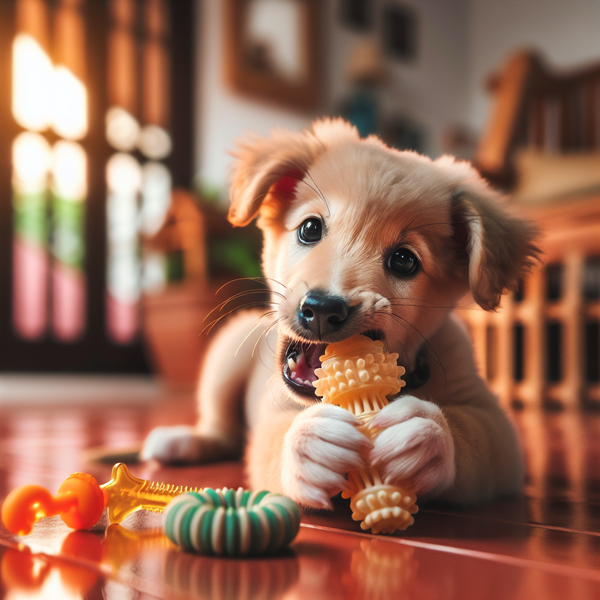
Choose the right toys. Puppies have preferences. Some love rubber toys like Kongs, others prefer rope toys or soft plush toys. Rotate toys to keep them interesting, and always have a variety available.
Make the toy more exciting than your hand. Wiggle it, drag it along the floor, or stuff it with a small treat. Your hand should become boring; the toy should become the best thing in the world.
Step 3: Use Positive Reinforcement Consistently
When your puppy makes good choices — chewing a toy instead of your hand, licking instead of biting, responding to redirection — mark that behavior and reward it.
Use a marker word or clicker. Say "yes!" the moment your puppy makes the right choice, then follow it with a small treat or praise.
Reward calm behavior. Don't just wait for biting to happen and then react. Actively notice and reward the moments when your puppy is calm, chewing an appropriate toy, or interacting with you gently.
Be consistent across your household. Everyone who interacts with the puppy needs to use the same approach. If one person lets the puppy nibble on their hands while another person redirects, you'll confuse the puppy and slow down progress significantly.
Step 4: Manage the Environment
Prevention is just as important as training. Set your puppy up for success by controlling their environment.
Use baby gates and exercise pens. These give your puppy a safe space and prevent them from practicing unwanted biting when you can't actively supervise.
Manage arousal levels. Rough play, wrestling, and high-energy games often lead to biting. That doesn't mean you can't play — just notice when your puppy is getting over-the-top excited and dial it back before biting starts.
Enforce nap times. Puppies need 18 to 20 hours of sleep per day. A puppy who has been awake for more than 60 to 90 minutes is probably overtired. If the biting escalates and nothing is working, your puppy likely needs a nap. Calmly place them in their crate or pen with a chew toy and let them rest.
Step 5: Teach an Incompatible Behavior
One of the most effective long-term strategies is teaching your puppy to do something that physically prevents biting.
"Touch" (hand target): Teach your puppy to boop your open palm with their nose. When they're targeting your hand with their nose, they can't bite it. This becomes a great default behavior during greetings and play.
"Sit": A sitting puppy is usually a calmer puppy. Teach a reliable sit and use it when your puppy starts getting mouthy.
"Go get your toy": Teach your puppy to grab a toy when they're excited. A mouth full of toy can't also be full of your fingers.
Redirection Strategies That Actually Work
Here are specific, tried-and-tested redirection techniques you can start using today:
The Toy Switch. The moment teeth touch skin, say "oops" in a neutral tone and present a toy. Praise enthusiastically when the puppy takes the toy.
The Freeze. When your puppy bites during play, go completely still and silent. Puppies find movement exciting — when you become boring, they often disengage on their own. Once they stop, calmly redirect to a toy.
The Reverse Timeout. Instead of putting the puppy in timeout (which can feel punishing), you leave the room for 15 to 30 seconds. The puppy learns that biting makes their favorite person disappear.
The Scatter Feed. If your puppy is in full "land shark" mode and nothing is getting through, toss a small handful of kibble on the floor. This activates their foraging instinct and immediately redirects their focus. It also gives you a moment to regroup.
What NOT to Do
Some outdated advice can actually make puppy biting worse. Avoid these approaches:
- Don't hold your puppy's mouth shut. This is frightening and can create fear-based aggression.
- Don't flip your puppy on their back (alpha rolls). This is based on debunked dominance theory and damages trust.
- Don't yell or use physical punishment. This teaches your puppy to fear you, not to stop biting. It often escalates the behavior.
- Don't spray your puppy with water or use bitter spray on your hands. These create negative associations and don't address the underlying cause.
- Don't push your puppy away. To a puppy, pushing is a game. You'll actually reinforce the behavior.
Realistic Timeline: When Will the Biting Stop?
Here's what to expect with consistent training:
Week 1 to 2: You'll see a reduction in the intensity of bites. Hard bites should start decreasing as your puppy learns that they end play.
Week 2 to 4: The frequency of biting during play should start to decrease. Your puppy will begin redirecting to toys more readily.
Month 2 to 3 of training: Biting during calm interactions should mostly stop. You may still see mouthing during high-excitement moments.
By 6 to 7 months of age: Most puppies have their adult teeth and the teething-driven biting subsides significantly. With consistent training, mouthy behavior should be minimal.
By 12 to 18 months: With continued reinforcement, most dogs have fully learned that teeth on skin is not acceptable.
A few important caveats: every puppy is different. Some breeds are mouthier than others — retrievers, herding breeds, and terriers tend to take longer. Progress isn't always linear; you'll have good days and bad days. That's completely normal.
When to Get Professional Help
Consider reaching out to a certified trainer if:
- Your puppy's biting is drawing blood regularly after several weeks of consistent training
- The biting seems aggressive rather than playful
- Your puppy guards resources (food, toys, resting spots) with biting
- You're feeling overwhelmed, frustrated, or scared of your puppy
- Your puppy is older than 6 months and the biting hasn't improved
A qualified professional can observe your specific situation and create a tailored plan. Look for trainers with CPDT-KA certification or veterinary behaviorists (DACVB).
You've Got This
Puppy biting is temporary. It feels relentless right now, but with consistent positive reinforcement, appropriate redirection, and a healthy dose of patience, your puppy will learn. Every gentle interaction, every successful redirection, every calm moment you reward is building the foundation for a well-mannered adult dog.
The fact that you're researching this topic tells me you care deeply about doing right by your puppy. That's already a huge advantage.
Want a quick-reference version of these techniques? Download our free PDF guide, 5 Quick Fixes for Puppy Biting, and pin it to your fridge for those moments when you need a fast answer with puppy teeth on your sleeve. Download the Free Guide →